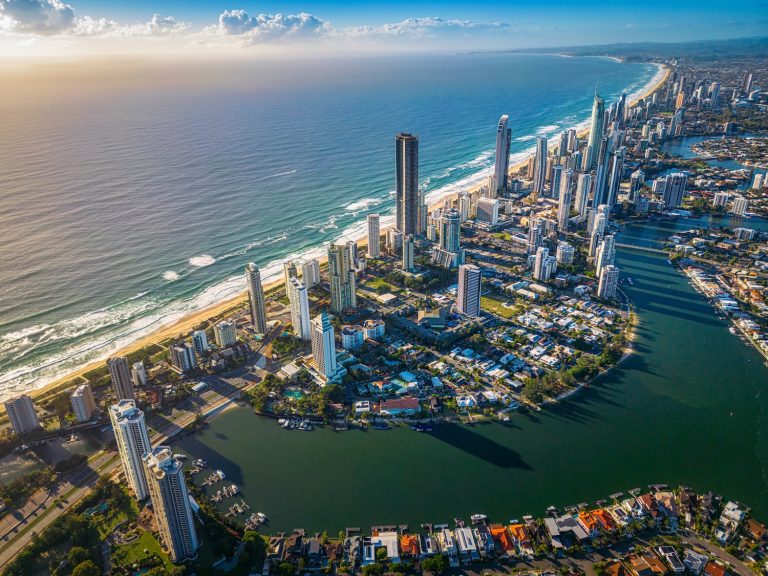
‘Ringfenced’: How build-to-rent and institutional rentals are set to become the new normal

Experts say the build-to-rent sector, untouched by federal budget-led tax changes and SMSF residential lending bans, has emerged as a more mature asset class attracting deep pockets and capital inflows.
On Friday, ABS lending indicators data provided the first real insight as to how private property investors reacted to federal budget changes.
The lending indicators data, which encompassed data for April through June – capturing loans written for six weeks post-budget – showed an 8.6% or $4.2 billion fall in new investment lending.
The reasons for the falls extend beyond changes to negative gearing and capital gains tax announced in the budget – it follows a 4.7% decline in the March quarter – and experts say the drawback in investment lending is compounded by elevated interest rates and other state-based taxation and rule changes.

Experts say BTR will become the new normal as private investors exit the market. Picture: Getty
Cushman and Wakefield told realcommercial.com.au the build-to-rent (BTR) sector is already benefiting, where institutional investors could pick up the slack from private residential investors.
Private investors currently have very few direct opportunities to invest in BTR, where capital is flowing from offshore institutional investors, particularly from Japan.
“The sector is well insulated from the challenges affecting the wider residential market and capital values should continue to grow,” said Josh Rose-Nokes, Cushman & Wakefield’s Director, Living Research, APAC.
“The budget reinforces a broader policy shift towards BTR as the main mechanism for new rental housing supply, as it is ringfenced from the new tax measures.”

Cushman and Wakefield’s Josh Rose-Nokes. Picture: Supplied
The Property Council of Australia/MSCI BTR index shows green shoots, recording a 7.1% total return in the year to March 2026, with annual income returns ranging from 3.5% to 3.9% and vacancy of 7.1% across stabilised assets – generally much tighter than other asset classes.
This places Australia’s BTR stock more in-line with maturer markets, such as the United Kingdom, where income returns ranged from 3.9% to 4.3% over the same period.
JLL estimates the multi-living and BTR sector transacted about USD $5.43 billion in the first half of 2026.
Developers are also miffed at the government’s ban on lending for residential property held within self-managed super funds (SMSF), saying it would diminish the supply of new homes as investors pivot from build-to-sell to BTR instead.
However, the capacity for a one-to-one substitution is limited.

Melbourne is one of the main beneficiaries of build-to-rent and PBSA projects. Picture: Supplied
“We are seeing selective reallocation at the development and capital-structure level, rather than a wholesale conversion of build-to-sell stock,” said Paul Savitz, Cushman & Wakefield’s Director, Living, Capital Markets, ANZ.
“Late-stage conversion activity may increase but is not straightforward because BTR requires different unit mixes, amenity, building management systems and operating infrastructure.
“The strongest opportunities are usually sites that can be redesigned for rental from an early stage.”
Conal Newland, Cushman and Wakefield’s international director, head of living, APAC, says Australia will continue to see further institutionalisation of rental markets.
“As Australia continues to confront housing affordability and supply challenges, build-to-rent will not be the sole answer. But it is rapidly becoming one of the most important pieces of the solution,” he said.

Cushman and Wakefield’s Conal Newland. Picture: Supplied
Renewed confidence in student housing
Alternate housing environments such as student housing are also shaping up to be a key indirect beneficiary as investors redeploy capital from traditional build-to-sell models.
Data from JLL shows Australia dominates the Asia-Pacific student housing boom, accounting for 61% of all transaction volume in the first half of 2026.
Volumes in the APAC region have tripled since 2022 – but Australia remains in a critical supply shortage, with student numbers up 30% from pre-pandemic levels, squeezing into a market where only 10% of all housing stock is designated for students.

Australia attracted the lion’s share of APAC purpose-built student accommodation in the first half of 2026. Picture: JLL
“Australia’s position as the gateway market for student housing in Asia Pacific is well-earned. We are witnessing a fundamental shift as the asset class transitions toward institutional mainstream status, moving beyond its specialist origins,” said Jack Bergin, JLL Australia’s head of living.
The past 12 months has seen foreign international student housing heavyweights such as Greystar, Mapletree, and M&G make their first moves in Australia, each with billions of dollars in assets under management.
Analysis by CBRE shows supply should soon follow, where purpose-built student housing (PBSA) could increase by a third or 34,000 if current building plans follow through – this is against a backdrop of a shortage of around 185,000 beds.

There is strong demand for purpose-built student accommodation. Picture: CBRE
Sameer Chopra, CBRE’s head of research, Pacific, pointed to the strengths of student housing.
“Student accommodation rents are currently at a 12% premium to rents for two-bedroom apartments in the same precinct,” Mr Chopra said.
“Today, nearly a quarter of PBSA standard suites have rents above $700/week. This used to be a phenomenon in Sydney and Melbourne but we’re seeing similar new stock with higher rents in Adelaide, Brisbane and Perth.”
The latest commercial property news
Get the latest news and insights straight to you.